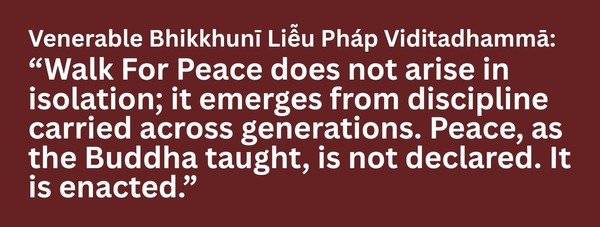
by Ajahn Canda
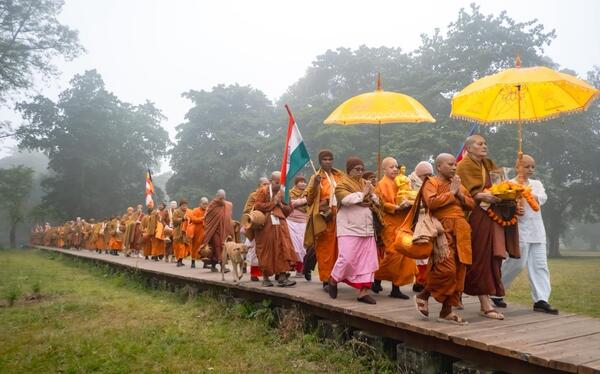
From the 16th until the 22nd of December, 2025, a sacred bhikkhuni pilgrimage took place in India. One hundred bhikkhunis and samaneris from numerous countries (including Nepal, Indonesia, Vietnam, Thailand, Cambodia, Bangladesh, Canada, Germany and Australia), walked in the footsteps of the great Arahant bhikkhuni, Mahapajapati Gotami who was the Buddha’s maternal Aunt. They followed the same 300 kilometre route that Mahapajapati herself had walked barefoot, along with five hundred other Sakyan women, to personally ask the Buddha for the “going forth” as bhikkhunis: from the Buddha’s hometown of KapilavastuinNepal, through Bihar and on to Vaishali. The Sakyan women of ancient India rebelled against the societal expectations placed upon women at that time and would have faced the very real dangers posed by would-be bandits and rapists along the way, yet their aspiration for freedom gave them the courage to risk their lives. Seeing their faith and bleeding feet, the Buddha accepted their request, acknowledging that women have the same capacity for awakening as men. Vaishali is thus revered as the birthplace of the Bhikkhuni Sangha.
The senior-most bhikkhuni on this modern-day pilgrimage was Guruma Sujata Shakya Mahatheri. The tallest bhikkhuni on the photo above, she carried the sacred relics of Mahapajapati Gotami. This was the first time these relics had returned to their homeland after their departure centuries ago. I was amazed and delighted to recognise Venerable Sujata Mahatheri in some of the photos, as the very first nun I got to know and respect deeply, in 2001. At that time I was a Pali student at Dhammagiri Vipassana Centre in India and my internal process of renunciation was gaining strong momentum, so I overcome with delight to discover that my Pali teacher was a nun ~ from the Buddha’s own clan! Each morning for many months my heart would soar to see Venerable Sujata Shakya and her attendant sweeping the grounds of their lodgings, their pink Burmese robes catching the early morning sun.
Only two weeks ago did I come to know that Venerable Sujata had already been a fully-ordained bhikkhuni when I was her Pali student, and since 1998. When I learned that this pilgrimage gave her the opportunity to rightfully don the ochre robes of a bhikkhuni for the first time (because the pink robes of an eight-precept nun are more readily accepted in some conservative Buddhist circles), I was deeply moved. Here was a direct descendent of those first Sakyan bhikkhunis facing obstacles in the modern day, yet persevering with the same strength and resolve as her foremothers, as she walked in their footsteps.
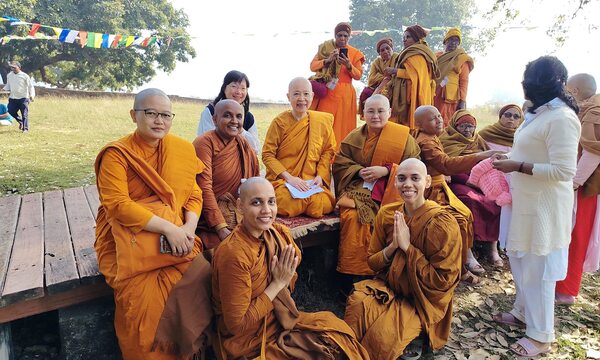
This photo shows two Indian bhikkhuni in the foreground who are daughters of a Vipassana teacher, and my Preceptor Venerable Santini Theri from Indonesia, in the middle with paper on her lap.
In an article by BuddhistDoor, the Indian bhikkhuni Venerable Vandana eloquently states the profound and wider significance of the pilgrimage thus: “When humanity faces violence and hatred, the compassion and the Middle Way taught by the Buddha are no longer just options, but the fundamental remedy for resolving crises.”
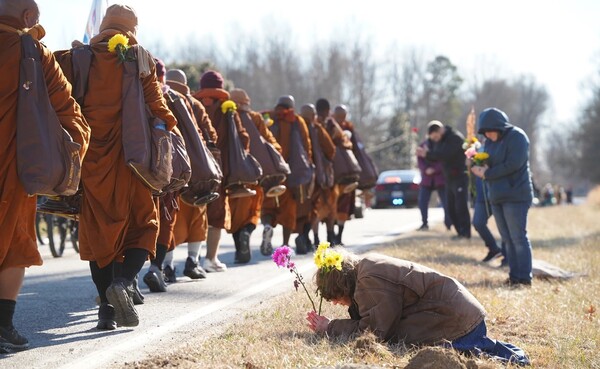
Meanwhile in the US, a group of twenty courageously compassionate monks, from countries such as Thailand and Vietnam, has gained global recognition, a large following and more recently, a nomination for the Nobel Peace Prize! Their 3,200 kilometre “Walk For Peace,” which began in Texas in October, is due to complete in Washington DC this coming week (around the 10th & 11th February). Official statements explain that:
“The walk for peace was created with a simple and sincere purpose: to cultivate peace through compassion, loving-kindness and mindfulness, and to bring peace to individuals, communities and the world. Our focus remains on walking together in harmony, sowing seeds of understanding, and allowing peace to arise organically – whenever conditions are wholesome and ready.”
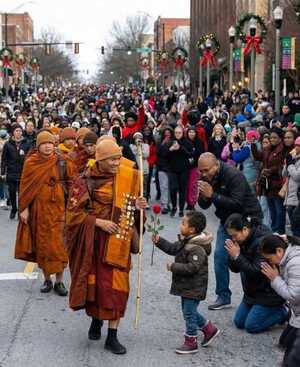
Stories of the Walk for Peace abound and the Vietnamese leading monk Bhante Pannakara and his rescue dog Aloka have become household names ~ beacons of light, love, compassion and hope. Of notable mention is the truck accident that happened early on in the journey that resulted in Bhante Phommasan Dam losing a leg. Despite this terrible adversity, it was said that his spirit remained strong and he expressed heartfelt encouragement and good wishes to the Sangha for a peaceful, safe and mindful continuation. I read inspirational words from him to the effect that the accident would not be in vain if their pilgrimage succeeds in spreading the message of and bringing people together in peace. It certainly has done that!
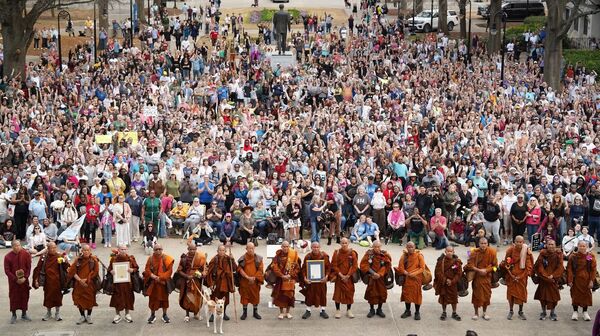
The outpouring of love and tears from the crowds gathering to meet and walk alongside the monks must be beyond anyone’s wildest reckonings or hopes. The images, stories and sheer emotional impact of this arduous faith walk ~ through snow storms and rain ~ go to show beyond doubt, that ordinary folks from all walks of life revere peace and yearn to form communities centred around the ethical values of mutual respect and love for all life ~ rescue-dog life included! Such communities grow quickly when people are inspired, potentially expanding to create equitable societies where everyone can flourish and find strength to remain steady and at peace, even in times of great adversity.